Parametric Estimation
MLE and hypothesis testing
Yu Cheng Hsu
Intended learning outcomes
- Define and formulate the likelihood function (\(\mathcal{L}_n(\theta)\)) as the joint density of IID observations
- Differentiate between MLE and Maximum A Posteriori (MAP) estimates, specifically how MAP incorporates a Bayesian prior
- Understand different hypothesis testing approach
Estimating distribution parameter from data
- In this session we focus on how to estimate the distribution parameters from the IID observed data \(X=x_1,\dots,x_n\)
- We assume \(X\) follows a specific distribution how can we know the paparemeter?
- If it follows a normal distribution, then what is the procedure
Intuitive guess
Using the sample mean, variance as the best guess
Likelihood
The likelihood function (\(\mathcal{L}_n(\theta)\)) is the joint density of IID observations \(X=x_1,\dots,x_n\) with PDF \(f(x;\theta)\), treated as a function of the parameter \(\theta\) given the fixed data.
\(\mathcal{L}_n(\theta)=\prod_{i=1}^nf(x_i|\theta)\)
- Likelihood is the product of the probabilities of observing \(X\) as a function of different \(\theta\).
- This is the observed data we see in calculating Bayesian posterior
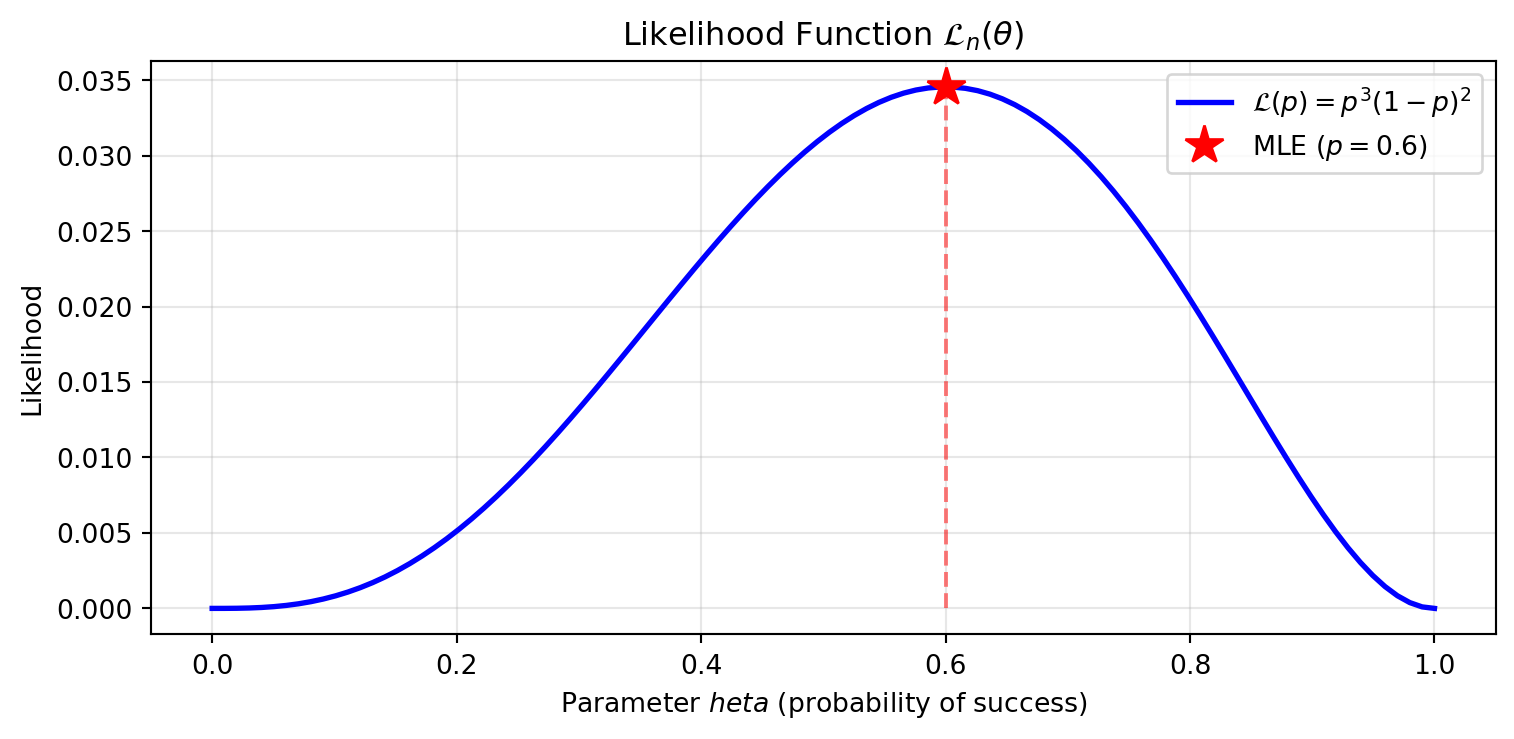
Example if \(X \sim \text{Bern}(p)\), and we observed \([1,0,0,1,1]\)
then the likelihood is
\[ \mathcal{L}_n(\theta) = p^3(1-p)^2 \]
Maximum likelihood
- The ideal \(\theta\) is the one (\(\hat{\theta}\)) that maximizes the likelihood (i.e., makes the observed data most probable). We call this the Maximum Likelihood Estimate (MLE).
- Calculus tells us the maximum of a function occurs where:
\(\small\frac{d\mathcal{L}_n(\theta)}{d\theta}=0 \quad \text{and} \quad \frac{d^2\mathcal{L}_n(\theta)}{d\theta^2}<0\)
Calculation notes
- Any positive constant multiplier \(c\) won’t affect the location of the maximum, so constants can be ignored.
- Taking the logarithm of the likelihood is often easier for calculation. We define the log-likelihood function as \(\ell_n(\theta)=\ln(\mathcal{L}_n(\theta))\). Reasons:
- Numerical stability
- Logarithms transform products into sums.
Example: Bernoulli MLE
if \(X \sim \text{Bern}(p)\), and we observed \([1,0,0,1,1]\)
we would like to maximize the likelihood
\[ \begin{aligned} \max_\theta\mathcal{L}_n(\theta) =& \max_\theta p^3(1-p)^2\\ \frac{d\mathcal{L}_n(p)}{dp} =& p^2(5p^2-8p+3) =0 \\ p = & 0,0.6, \text{or } 1 \\ \frac{d^2\mathcal{L}_n(p)}{dp^2} =& 20p^3-24p^2+6p \\ \mathcal{L}^{''}_n(0) = 0 , & \mathcal{L}^{''}_n(0.6) = -0.72, \\ \mathcal{L}^{''}_n(1) =& 2 \end{aligned} \]
The MLE estimation is 0.6, which is exactly the sample mean
Maximum A Posteriori (MAP) Estimate
- The idea of maximizing \(p(\theta|x)\) is called maximum a posteriori (MAP) estimate, the problem has the following format
\[ \begin{aligned} \hat{\theta}_{MAP}= &\arg\max_\theta p(\theta|x) = \arg\max_\theta \frac{p(x|\theta)p(\theta)}{\int_\Theta p(x|\theta)p(\theta)d\theta} \\ = & \arg\max_\theta p(x|\theta)p(\theta) \end{aligned} \]
Implication
- MAP is the mode of the posterior distribution.
- It acts as a bridge between Frequentist MLE and full Bayesian inference.
Example: Bernoulli MAP
if \(X \sim \text{Bern}(p)\), and we observed \([1,0,0,1,1]\), We have a prior on \(p\sim \text{Beta}(2,2)\)
What is the MAP estimate of \(p\)
Hardcore calculus
\[ \begin{aligned} \arg\max_p p(p|x) & = \arg\max_p p^3(1-p)^2 \cdot p^{2-1}(1-p)^{2-1} \\ \frac{d}{dp} [p^4(1-p)^3] &= 4p^3(1-p)^3 - 3p^4(1-p)^2 \\ & = p^3(1-p)(p-1)(7p-4) =0 \\ p & = 0, 1, 4/7 \\ \text{Second derivative test confirms} & \text{ maximum at } p = 4/7 \end{aligned} \]
Example: Bernoulli MAP
Using Conjugate Priors
\[ \begin{aligned} p(p|x) & \sim \text{Beta}(\alpha', \beta') \\ \alpha' &= \alpha + \sum x_i = 2 + 3 = 5 \\ \beta' &= \beta + (n - \sum x_i) = 2 + 2 = 4 \end{aligned} \]
The MAP (mode) for \(\text{Beta}(\alpha, \beta)\) is \(\frac{\alpha-1}{\alpha+\beta-2} = \frac{5-1}{5+4-2} = \frac{4}{7} \approx 0.57\).
Takeawys
MLE
- Maximizes the probability of the data given parameters: \(p(x|\theta)\).
- For common distributions, MLE often corresponds to:
- Sample mean (\(\bar{x}\))
- Sample variance (\(s^2\))
- Guaranteed to have asymptotic properties (consistency and efficiency) as \(n \to \infty\).
MAP
Maximizing the posterior (observed data+ prior)
\[ p(\theta|x)\propto p(x|\theta)p(\theta) \]
- MLE only maximize the \(p(x|\theta)\) without considering \(p(\theta)\)
- Intuitively, the \(p(\theta|x)\) has the maximum at the posterior mean
- Not the optimal estimation but incorporate with prior
Statistical inference
Preface
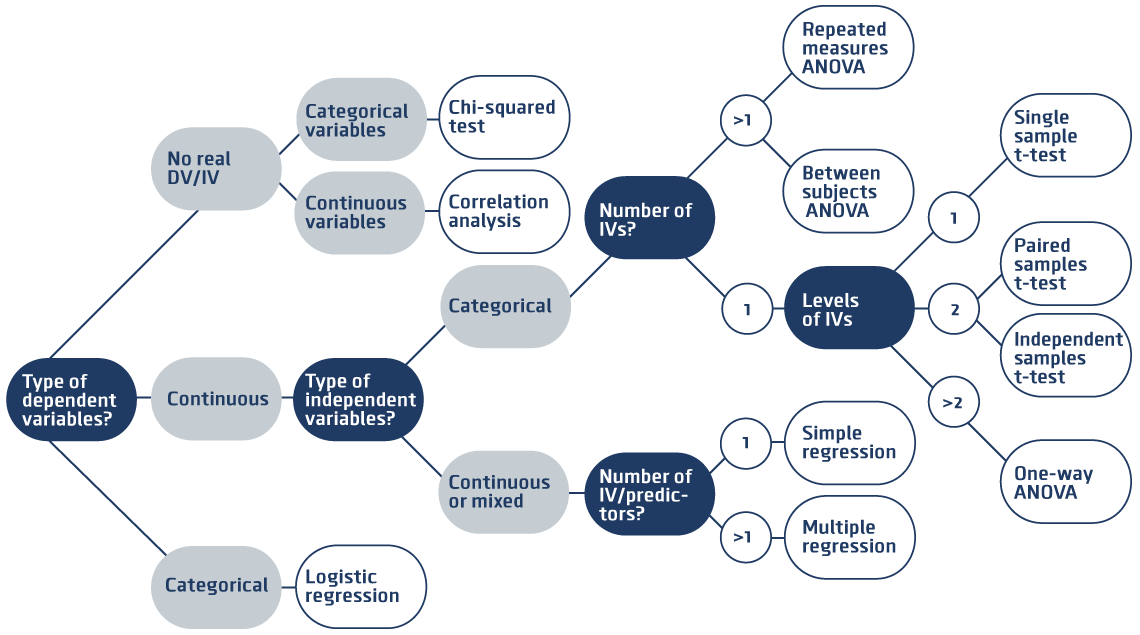
- This topic is highly correlated with BIOF2013, but we will focus more on the underlying mechanics of why these tests work.
- In BIOF2013, we have introduced several hypothesis test methods
The Wald Test
Considering a two-tailed test
\[ H_0=\theta=\theta_0 \text{ v.s. } H_1=\theta\neq\theta_0 \]
Assumes \(\hat{\theta}\) is asymptotically Normal
\[ W=\frac{\hat{\theta}-\theta_0}{\hat{se}}\leadsto N(0,1) \]
Important thing
- Requires sufficient sample size for the CLT to ensure \(\hat{\theta}\) is asymptotically Normal.
- The p-value is \(P(|W| \geq |W_{obs}| \mid H_0)\), not the probability that the null hypothesis is true.
Likelihood ratio test (LRT)
A more general way incorporating for a multivariate parameters (i.e. a vector-based parameter \(\theta=(\theta_1,\dots,\theta_n)\)) is likelihood ratio test. The general form is
\[ H_0=\theta\in\Theta_0 \text{ v.s. } H_1=\theta\notin \Theta_0 \]
The test statistics
\[ \Lambda = -2\ln\left(\frac{\mathcal{L}(\hat{\theta}_0)}{\mathcal{L}(\hat{\theta})}\right) \leadsto \chi^2_{df} \]
Implication
- Likelihood ratios provide a powerful framework for comparing nested models.
- This method can be used in test regression
- Asymptotic assumption
Application of LRT
- Chi-square test on 2x2 contingency table
- We can treat each cell as multinomial distribution outcome
- We are simultaneously estimating 2 probability on two variables
- Multinomial distribution parameter hypothesis testing
- Regression: goodness-of-fit test
Discussion question
Why do we use Fisher’s exact test instead of the \(\chi^2\) test for small sample sizes?
Comparison of LRT and Wald Test
- In a single parameter setting, both Wald test and LRT have similar power and results.

Discussion question
What are the difference of Wald test with multiple comparison correction and LRT?
Permutation test
The permutation test is a non-parametric method with minimal assumptions about the underlying distribution.
- Suppose that \(X \sim F_X\) and \(Y \sim F_Y\)
- The hypothesis is \(H_0: F_X = F_Y, H_1 \neq F_Y,\)
- Observed samples \(x_1,\dots, x_m\) and \(y_1,\dots, y_n\).
- Test statistic \(T_{obs} = |\bar{x}_m - \bar{y}_n|\).
Procedure
- Compute the observed test statistic \(T_{obs}\).
- Randomly shuffle (permute) the group labels many times (\(B\)).
- Calculate the statistic \(T_j\) for each permutation.
- The approximate p-value is \[ \frac{1}{B}\sum_{j=1}^B I(T_j \geq T_{obs}) \]